Jessica Wachtel at The New Stack tested Cursor's new Jira integration and gave it "5 stars, no notes."
Credit where it's due: it's impressive. Cursor's integration is the real deal. So is the whole cloud-agent wave. Cursor, Conductor.build, all of it. But I'd rarely set anything loose on a raw Jira ticket. Half the job is often figuring out what the ticket's saying in the first place!
So I ran two of the same HTTPie tasks through Cate's measure twice, cut once approach.
The Ticket Isn't the Prompt
Ask Cate's planner to start with a Jira ticket, and it won't start in on code. It won't even delegate it until it's turned it into a real spec, interviewed you about any vague bits, and cross-referenced it against existing standards, guardrails, and institutional knowledge.
The bug
Take Wachtel's clearly-written bug:
Content-Type: application/json goes missing from verbose output
when a POST has exactly one custom header. Cursor fixed it and added a test.
Five stars.
So did Cate: same fix, regression tests added, full suite passing.
The difference? I knew what I was getting before any code was written, and the ticket got enriched to keep this bug from ever coming back. Root cause analysis, the version story, and the key decisions behind the fix, straight from our Jira:
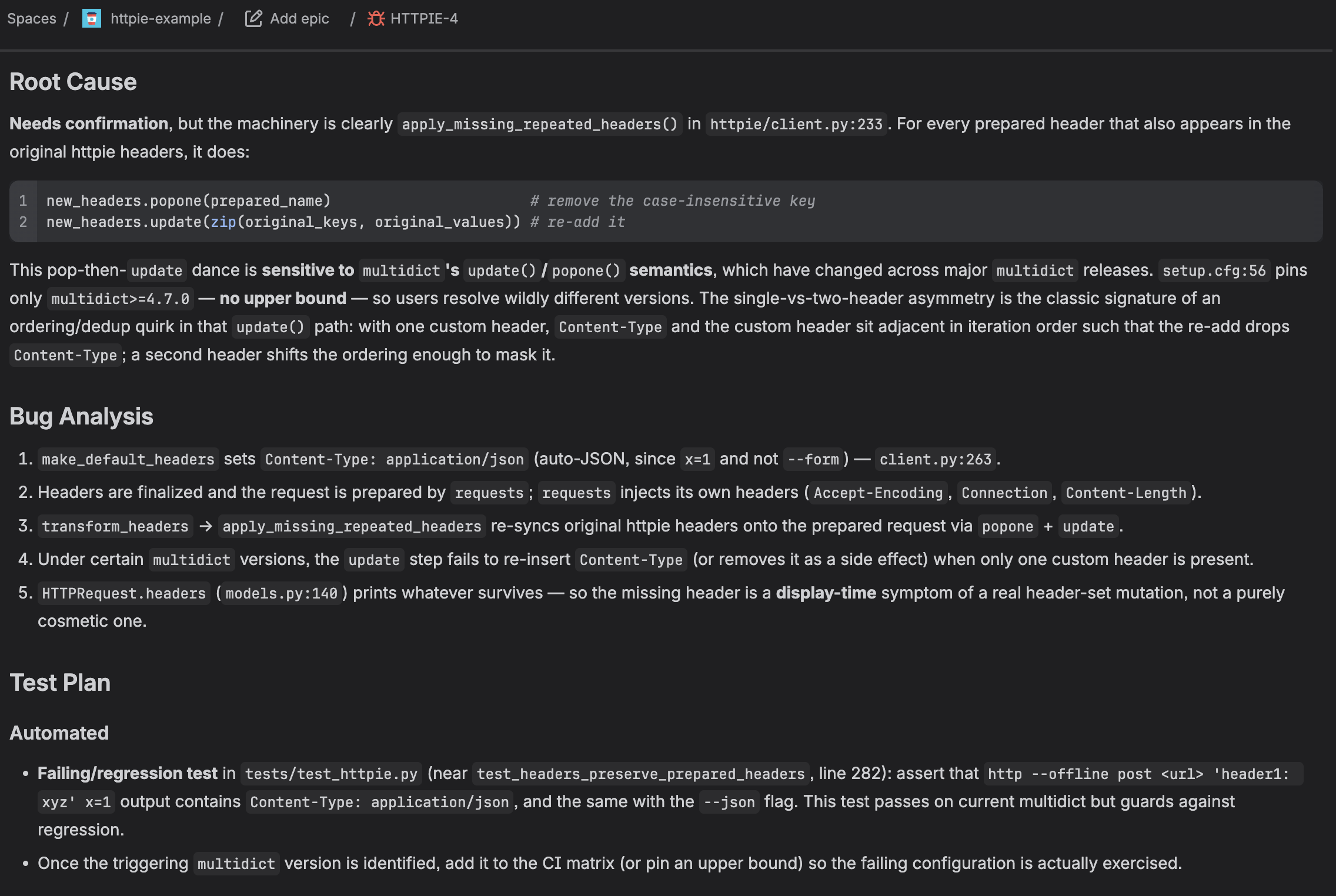
The next person who hits a weird header bug doesn't start from zero. They start from that.
The feature
The vague feature ticket is where this got fun. Wachtel's version: "save
responses without manually redirecting output every time." Cursor turned that
into a complete --save flag with auto-generated filenames,
collision handling, and a companion --save-dir, all on its own.
Genuinely impressive.
Also: whoa, Nelly. That two-sentence ticket just changed the UX surface of an application. New flags, new behaviors, new things users have to learn. Don't you think we should talk about it first?
Cate made me talk about it. The planner interviewed me before delegating
anything, and somewhere in that conversation we realized a new flag isn't just
code: it's --help output, a changelog entry, the README. Docs went
into the acceptance criteria before a line was written.
Then I customized Cate's reviewer instruction for this project. If anything changes the CLI without updated help, the review immediately fails. That's the Cate pattern: humans and agents contribute to institutional knowledge and standards, and agents enforce them every time.
The Boring Stuff That Decides Adoption
Price. The Cursor/Jira integration requires Cursor Teams: $40 per user per month, no trial (Wachtel's four-ticket test cost her a little over $40). Cate is free on public repos, and $14/month unlocks everything. And because Cate aggregates token cost per Jira issue, you don't find out what a task cost from your monthly bill. Every ticket carries its own price tag.
Your tokens, your machine. Cloud agents are cool. They're also a non-starter for a lot of teams in regulated industries or government. Cate drives the coding agents you already have, Claude Code or OpenCode, on your own machine. Your subscription, your API keys, your hardware. And "local" doesn't mean "loose on your laptop": Cate can run its agents in Docker sandboxes, so you get cloud-style isolation without the cloud. There's no middleperson tax on your tokens, because there's no middleperson.
Integration. Cursor-in-Jira needs a marketplace app installed by an admin, Jira Commercial Cloud, Rovo enabled, and usage-based billing turned on. If you've ever tried to get a new product added to a corporate Atlassian instance, you know that's not an afternoon. It's a procurement ticket. Cate connects to the Jira you already have with OAuth or a personal API token. No new apps, no admin campaign, no waiting.
I Owned the Ticket. I Owned the Change.
The ticket was assigned to me. The spec was approved by me. The review rule exists because I caught the gap. I just got help writing a good spec and the PR.
When someone asks who made the fix, there's no hands-in-pockets mumbling about "the AI did it." It's me. Agents do the work; I own the work.
Cut Once
Wachtel ended her five-star review with a caveat worth quoting in full: "I would have no problem asking Cursor to vibe code a prototype or personal software via Jira tickets. Would I trust this in production software? Not yet."
That gap, between a great demo and a production change you'd sign your name to, is exactly where Cate lives. Same Jira board. Same agents doing the heavy lifting. Just a little more measure-twice-cut-once: a spec you agreed to, a review gate you can teach, and a trail that ends with your name on it.
Let's add "just enough" planning to your AI workflow. Download Cate, or get in touch. We'd love to hear how your team works.